Personalized Development Is Finally Possible. HR Still Can’t Scale It.
HR has spent decades modernizing the “transaction layer” of work: payroll, benefits, onboarding, compliance workflows. That automation mattered—but it also created an expectation gap.
Once the basics are handled, leaders ask the obvious next question: What comes next?
In a recent Wall Street Journal interview, Allison Elias described the opportunity plainly: cloud platforms now hold rich data about employees—skills, background, training history, learning preferences, performance context—making individualized development paths genuinely possible. The catch is just as clear: most HR teams are not staffed or structured to deliver that promise at scale. Compliance consumes the day, budgets stay tight, and development work requires judgment, coordination, and follow-through.
That is the modern talent paradox: the data exists, the need is urgent—and the operating model cannot keep up.

The Hidden Cost of “Not Moving People”
Most organizations treat internal mobility as an HR program. In reality, it is a business performance lever with a measurable cost of delay.
When internal mobility is slow or inconsistent:
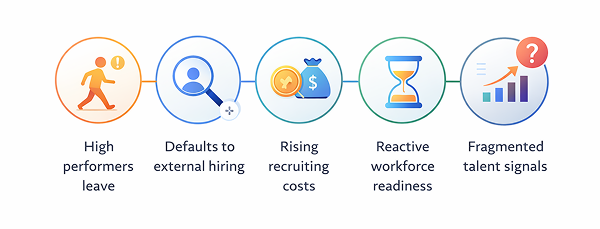
High performers leave because they cannot see a future inside the company.
Managers default to external hiring because it feels faster and safer.
Recruiting costs rise, time-to-fill increases, and teams stay under-capacity longer.
Workforce readiness becomes reactive: training happens after the need is urgent, not before.
Leaders lose confidence in talent decisions because signals are fragmented and hard to compare.
This is not a motivation problem. It is a systems problem.
The traditional approach depends on heroic effort: HR partners manually triangulate job architectures, role requirements, learning resources, location constraints, and compensation bands—then attempt to make guidance “personal” for thousands of employees. Even excellent HR teams cannot do that repeatedly, on demand, across the enterprise.
What “Personalized Development” Actually Requires
Personalized development is not a slogan. It is an operational capability that must answer three questions—instantly, consistently, and with governance:
What roles are realistic next moves for this employee?
Based on their profile and organizational context—not generic ladders.What are the specific skill gaps to close for a target role?
Actionable gaps mapped to role requirements.What is the shortest path to readiness?
A tailored learning plan aligned to business needs.
Most companies can answer these occasionally for a small subset of employees. The challenge is answering them at scale, continuously, and with confidence.
That is the gap between having data and having a system that converts data into decision-ready development.
Introducing Vertis Career Pathfinder
Vertis Career Pathfinder is an AI-powered platform that makes internal mobility decision-grade—so leaders can move talent internally with confidence and employees can take clear, actionable steps toward growth.
Career Pathfinder exists for one reason: personalized development is now possible; but HR cannot scale it alone.
It helps organizations:
Reduce attrition by making growth paths visible and achievable.
Lower hiring costs by increasing internal fill and reducing unnecessary external search.
Improve workforce readiness by turning transitions into proactive pathways.
It does this by turning the data you already have—HRIS, job architecture, learning history, location constraints, compensation bands—into a governed system of mobility insights and actions.
What Career Pathfinder Delivers
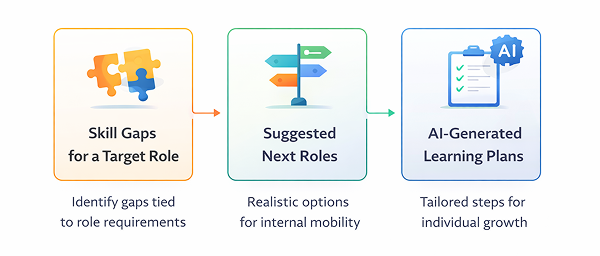
Career Pathfinder focuses on three high-leverage workflows that unlock internal movement at scale:
1) Skill Gaps for a Target Role
Employees and leaders see what is missing between “where I am” and “where I want to go”—specific gaps tied to role requirements.
2) Suggested Next Roles
Career Pathfinder surfaces realistic next roles based on employee profile and organizational context—better options leaders can defend and employees can pursue.
3) AI-Generated Learning Plans
Career Pathfinder turns gaps into a structured, tailored learning plan—clear steps and sequencing at the level of each employee, not just broad programs.
Why This Matters for Business Leaders (Not Just HR)
If you run a business unit, the cost of stalled mobility shows up as open roles that drag on, capability gaps that block execution, regrettable attrition that resets momentum, and expensive hiring decisions.
Internal mobility becomes a speed advantage when leaders can confidently redeploy and develop the talent they already have. Career Pathfinder is built to enable that outcome by giving leaders visibility and the confidence to act.
Reducing the HR–IT Bottleneck
Elias also called out a critical truth: improving development requires HR–IT collaboration—yet many organizations still struggle to use the data already in their cloud platforms. Every new question becomes bespoke analysis. The work does not compound.
Career Pathfinder reduces that friction through a governed data layer, less bespoke work to answer each new development question, and faster iteration as leaders refine how mobility decisions get made.
It is not “AI replacing HR.” It is AI scaling the parts of HR that have become impossible to scale manually.
A Simple, Uncomfortable Truth
If you cannot personalize development, you will lose your best people—regardless of compensation.
Not because they are disloyal. Because they are rational. High performers will not wait indefinitely for growth paths that only exist in managers’ heads or in HR spreadsheets.
The organizations that win will treat internal mobility as a core operating capability—not an annual talent exercise.
Where This Goes Next
Career Pathfinder is how organizations unlock hidden talent already inside their workforce.
If you want to see how this works in practice—or explore a pilot program—contact Vertis to learn how Career Pathfinder can become your internal mobility engine.